
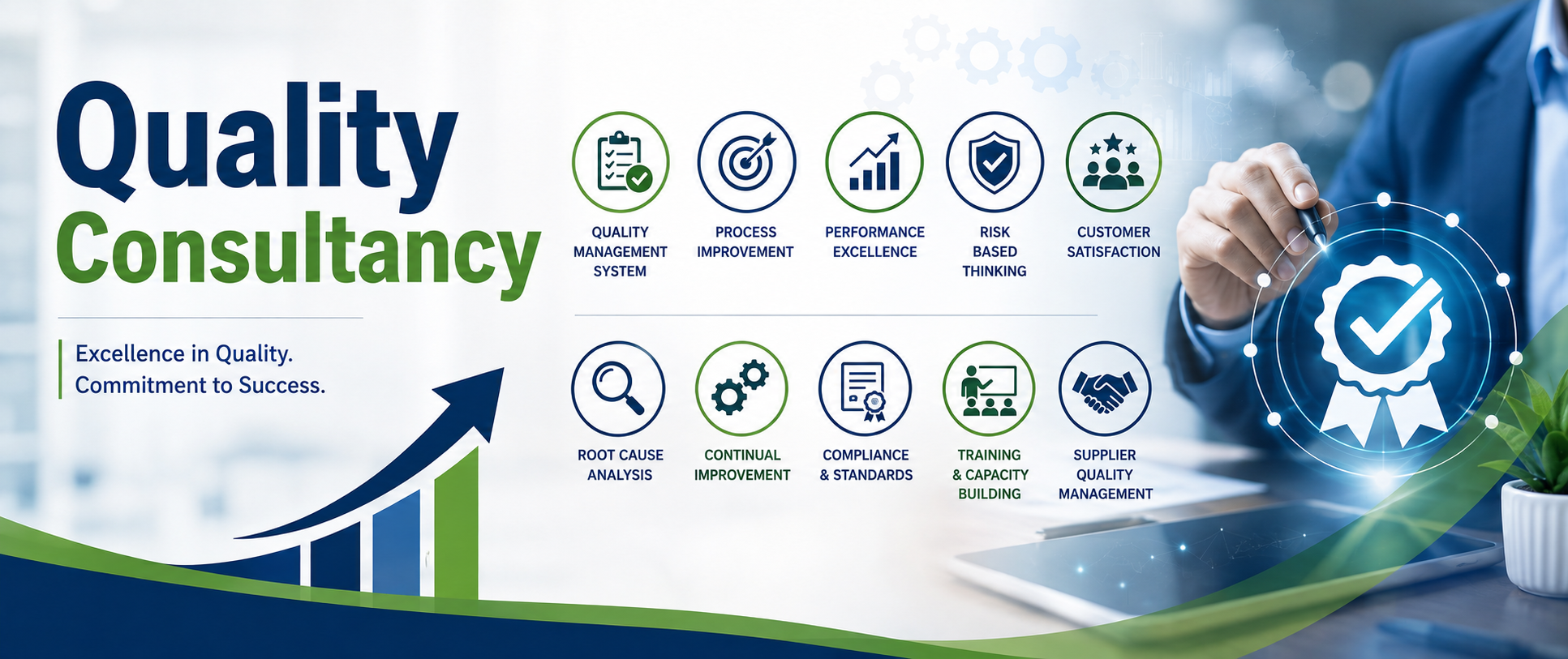
Quality Consultancy Services
Quality Consultancy helps organizations improve processes, product and service quality, productivity and overall business performance. Akshar Management Consultant provides practical quality consultancy covering business process improvement, Lean, Kaizen, 5S, Six Sigma, root cause analysis, quality management, process optimization, waste reduction and continual improvement to help organizations achieve consistent and measurable results.
What is Quality Consultancy?
Quality Consultancy is professional support provided to organizations to improve the quality and performance of their products, services, processes and operations.
A Quality Consultant helps organizations identify problems, analyze processes, determine root causes and implement practical improvement solutions. Depending on the organization’s requirements, Quality Management Consultancy may focus on process improvement, waste reduction, productivity, quality control, customer satisfaction, problem solving or continuous improvement.
Unlike consultancy focused only on certification, our Quality Consultancy Services focus on improving the way work is performed and helping organizations achieve measurable and sustainable improvements.
Key Areas Covered in Quality Consultancy
Our Quality Consultancy services can cover a wide range of organizational improvement areas, including:
- Business Process Improvement
- Process Improvement
- Process Mapping
- Process Optimization
- Lean
- Kaizen
- 5S
- Six Sigma
- Lean Six Sigma
- Quality Assurance
- Quality Control
- Quality Planning
- Quality Risk Management
- Root Cause Analysis
- 7 QC Tools
- Corrective Action
- Customer Complaint Management
- Productivity Improvement
- Waste Reduction
- Process Standardization
- Performance Improvement
- Continuous Improvement
Our Quality Consultancy Services
Our Quality Consultancy Services cover a broad range of quality and business improvement requirements.
Business Process Improvement Consultancy
Our Business Process Improvement Consultancy helps organizations analyze existing processes and identify opportunities to improve efficiency, quality, productivity and customer value.
We examine how processes are performed, identify unnecessary activities and process gaps, and support the development of improved workflows and controls.
Key areas include:
- Business process analysis
- Process mapping
- Workflow improvement
- Process standardization
- Process optimization
- Performance measurement
- Process control
- Continual improvement
Process Improvement Consultancy
Our Process Improvement Consultancy focuses on improving individual operational and support processes to make them more effective, efficient and consistent.
We help organizations identify process problems, analyze causes, establish improvement actions and monitor results.
Process improvement may address:
- Delays
- Rework
- Errors
- Bottlenecks
- Process variation
- Unnecessary activities
- Poor coordination
- Inefficient workflows
Lean Consultancy
Our Lean Consultancy services help organizations identify and reduce activities that do not add value to customers or the organization.
We support organizations in applying Lean principles to improve process flow, reduce waste and increase operational efficiency.
Lean Consultancy may include:
- Waste identification
- Waste reduction
- Value-added analysis
- Process flow improvement
- Standardized work
- Visual management
- Workplace organization
- Continuous improvement
Kaizen Consultancy
Our Kaizen Consultancy services help organizations establish a culture of continuous, incremental improvement.
Kaizen encourages employees to identify problems and improvement opportunities within their areas of work and participate in implementing practical solutions.
Kaizen activities may focus on:
- Productivity improvement
- Quality improvement
- Waste reduction
- Workplace efficiency
- Safety improvement
- Cost reduction
- Process improvement
5S Consultancy
Our 5S Consultancy services help organizations improve workplace organization, cleanliness, standardization and discipline.
We support organizations in implementing practical 5S practices that can improve workplace efficiency and provide a foundation for continuous improvement.
The 5S approach covers:
- Sort
- Set in Order
- Shine
- Standardize
- Sustain
Quality Assurance Consultancy
Our Quality Assurance Consultancy services help organizations establish systematic approaches for preventing quality problems and maintaining consistent process performance.
We support organizations in reviewing quality processes, controls, responsibilities and performance monitoring methods.
Key areas may include:
- Quality planning
- Process controls
- Quality objectives
- Quality monitoring
- Quality assurance processes
- Corrective action
- Continual improvement
Quality Control Consultancy
Our Quality Control Consultancy services focus on identifying and controlling quality problems during relevant processes.
We support organizations in strengthening inspection, testing, monitoring and control practices appropriate to their products and processes.
Six Sigma Consultancy
Our Six Sigma Consultancy services help organizations use structured, data-based approaches to reduce process variation and improve quality.
Depending on the organization’s requirements, we can support improvement initiatives involving data analysis, process performance evaluation, root cause identification and corrective action.
Lean Six Sigma Consultancy
Our Lean Six Sigma Consultancy combines Lean principles for waste reduction and process flow improvement with Six Sigma approaches for reducing variation and improving process performance.
This approach can be applied to manufacturing, service and business processes where organizations are seeking structured performance improvement.
Quality Tools Consultancy
We help organizations understand and apply appropriate quality tools for process monitoring, problem solving and improvement.
Depending on the application, this may include the 7 QC Tools, Pareto analysis, cause-and-effect diagrams, check sheets, histograms, control charts and process flow diagrams.
Productivity Improvement Consultancy
Our Productivity Improvement Consultancy helps organizations identify opportunities to improve output, process efficiency and resource utilization.
We analyze relevant processes to identify delays, waste, bottlenecks and other factors that may affect productivity.
Continuous Improvement Consultancy
Our Continuous Improvement Consultancy helps organizations establish systematic approaches for identifying, prioritizing and implementing improvement opportunities.
The objective is to make improvement part of normal business operations rather than treating it as a one-time project.
Process Mapping and Process Optimization
We support organizations in developing clear process maps to understand the relationship between activities, inputs, outputs, responsibilities and controls.
Process Optimization Consultancy can help organizations simplify workflows, eliminate unnecessary steps, clarify responsibilities and improve process performance.
Process mapping can also support organizations implementing ISO 9001 and other management systems.
Root Cause Analysis Consultancy
Our Root Cause Analysis Consultancy helps organizations move beyond correcting symptoms and systematically investigate the underlying causes of problems. We can support organizations in applying appropriate problem-solving techniques to quality issues, process failures, customer complaints and recurring nonconformities.
Common approaches include:
- 5 Why Analysis
- Fishbone / Ishikawa Analysis
- Cause-and-effect analysis
- Problem-solving methodology
- Corrective action analysis
Benefits of Quality Consultancy
Improved Process Efficiency
Process analysis and optimization can help identify unnecessary activities, delays and inefficient workflows.
Reduced Waste and Rework
Lean and process improvement techniques can help organizations identify opportunities to reduce waste, errors and rework.
Improved Product and Service Quality
Better process controls and systematic problem solving can support greater consistency in products and services.
Improved Productivity
Process optimization and waste reduction can help organizations make better use of available resources.
Better Problem Solving
Structured root cause analysis helps organizations address underlying causes rather than repeatedly treating the same problems.
Greater Employee Involvement
Kaizen and continuous improvement approaches can encourage employees to participate in identifying and implementing improvements.
Improved Customer Satisfaction
Better process performance and consistent product or service quality can contribute to improved customer satisfaction.
Sustainable Continuous Improvement
A structured improvement approach helps organizations continue identifying and implementing improvement opportunities over time.
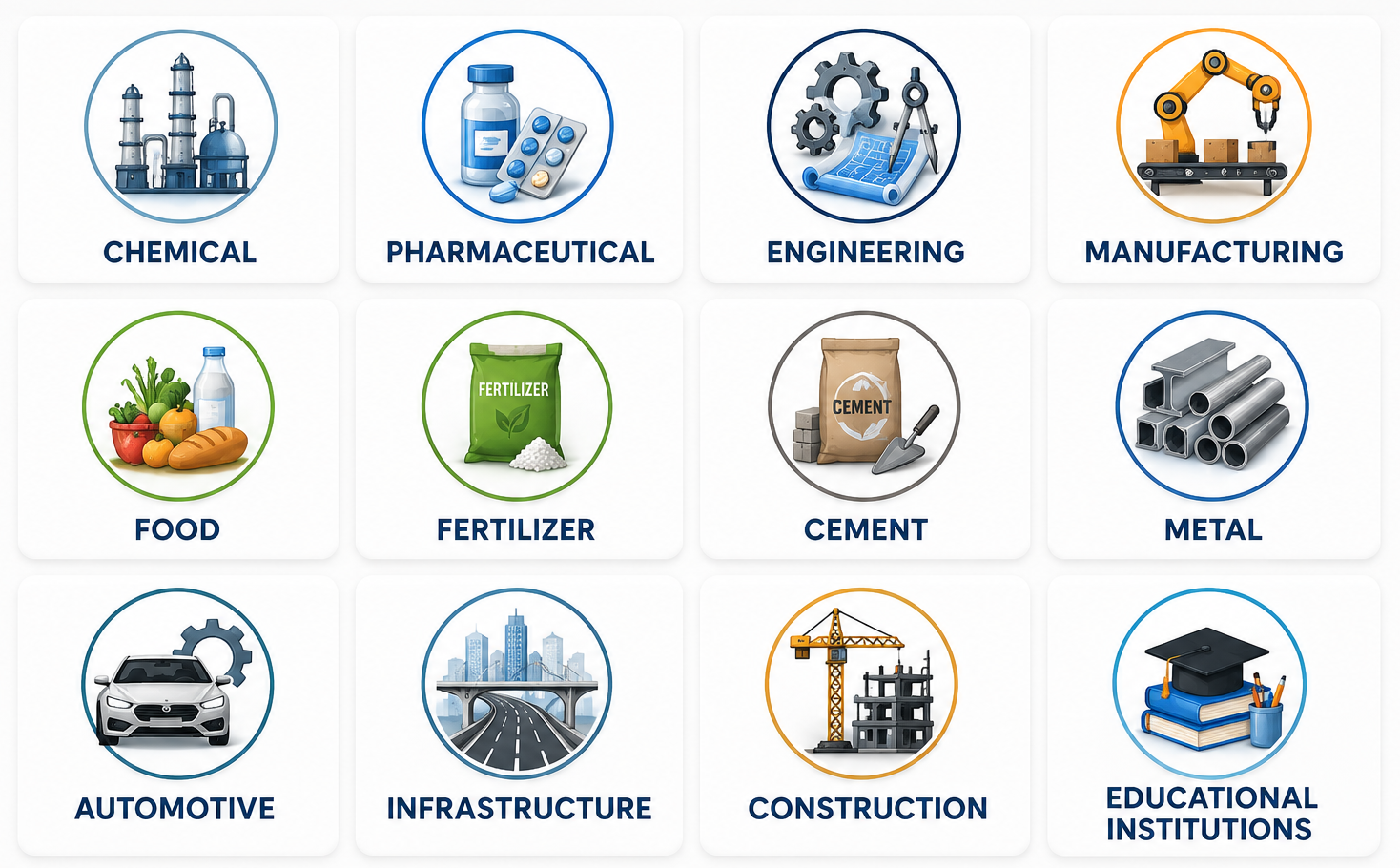
Who Needs Quality Consultancy?
- Manufacturing organizations
- Engineering companies
- Ceramic industries
- Chemical industries
- Pharmaceutical organizations
- Food and beverage organizations
- Construction companies
- Logistics and warehousing
- IT and technology organizations
- Healthcare organizations
- Educational institutions
- Service organizations
- Small and medium-sized enterprises
Why Choose Akshar Management Consultant for Quality Consultancy?
Practical Improvement Approach
Our Quality Consultant focuses on practical improvements that can be applied to your organization’s actual processes and operational environment.
Beyond ISO Certification
Our Quality Consultancy focuses on improving business performance and processes, not only achieving or maintaining ISO certification.
Multiple Improvement Methodologies
We can apply appropriate approaches such as Lean Consultancy, Kaizen Consultancy, 5S, Six Sigma, process improvement and structured problem solving based on the organization’s requirements.
Customized Solutions
Our Quality Improvement Consultancy is adapted to your organization’s processes, challenges, resources and improvement objectives.
Implementation-Focused Support
We focus on helping organizations implement improvements and monitor their effectiveness rather than simply providing recommendations.
Frequently Asked Questions About Quality Consultancy
Why does a company need Quality Consultancy?
- Organizations may use Quality Consultancy to improve process efficiency, reduce waste and rework, improve product or service quality, increase productivity, solve recurring problems and establish a culture of continuous improvement.
Is Quality Consultancy only related to ISO 9001?
- No. Quality Consultancy is broader than ISO 9001. It can include Business Process Improvement, Lean, Kaizen, 5S, Six Sigma, Quality Control, Quality Assurance, Root Cause Analysis, Process Optimization and productivity improvement.
What is Business Process Improvement Consultancy?
- Business Process Improvement Consultancy helps organizations analyze existing business processes and identify opportunities to improve efficiency, quality, productivity and customer value.
What types of processes can be improved?
- Almost any business or operational process can be reviewed, including production, procurement, sales, customer service, maintenance, quality control, inventory, logistics, administration and support processes.
What is Process Improvement Consultancy?
- Process Improvement Consultancy focuses on identifying inefficiencies, bottlenecks, delays, errors, unnecessary activities and process variation and developing practical improvements.
What is Process Optimization Consultancy?
- Process Optimization Consultancy helps organizations improve workflows by simplifying activities, eliminating unnecessary steps, improving resource utilization and strengthening process controls.
Do you provide Process Mapping Consultancy?
- Yes. Process Mapping Consultancy helps organizations visually document processes, inputs, outputs, activities, responsibilities, interfaces and controls to identify improvement opportunities.
What is Lean Consultancy?
- Lean Consultancy helps organizations identify and reduce non-value-added activities and waste while improving process flow, efficiency and customer value.
What types of waste can Lean Consultancy address?
- Depending on the process, Lean improvement can address overproduction, waiting, transportation, overprocessing, inventory, motion, defects and underutilization of people and skills.
What is Kaizen Consultancy?
- Kaizen Consultancy helps organizations establish a structured approach to continuous, incremental improvement by encouraging employees to identify and implement practical improvements.
How can Kaizen improve an organization?
- Kaizen can help organizations identify small improvements in daily work that collectively contribute to better quality, productivity, efficiency, safety and workplace performance.
Do you provide 5S Consultancy?
- Yes. 5S Consultancy helps organizations improve workplace organization, cleanliness, standardization and discipline through the systematic application of the 5S methodology.
What are the five steps of 5S?
- The five steps are Sort, Set in Order, Shine, Standardize and Sustain.
What is Six Sigma Consultancy?
- Six Sigma Consultancy helps organizations use structured, data-based methods to reduce process variation, improve quality and address recurring process problems.
What is Lean Six Sigma Consultancy?
- Lean Six Sigma Consultancy combines Lean principles for reducing waste and improving process flow with Six Sigma methods for reducing variation and improving process performance.
Do you provide Root Cause Analysis Consultancy?
- Yes. Root Cause Analysis Consultancy helps organizations investigate quality and process problems to identify their underlying causes and implement appropriate corrective actions.
Which Root Cause Analysis techniques can be used?
- Depending on the problem, techniques may include 5 Why Analysis, Fishbone Diagram, Cause-and-Effect Analysis, Pareto Analysis and other structured problem-solving methods.
What is Quality Assurance Consultancy?
- Quality Assurance Consultancy helps organizations establish systematic processes for preventing quality problems and ensuring that products, services and processes consistently meet defined requirements.
What is Quality Control Consultancy?
- Quality Control Consultancy focuses on monitoring, inspection, testing and controlling product and process characteristics to identify and address quality problems.
What is the difference between Quality Assurance and Quality Control?
- Quality Assurance focuses primarily on preventing quality problems through systematic processes, while Quality Control focuses on identifying and controlling quality issues through monitoring, inspection and testing.
Do you provide Quality Management System Consultancy?
- Yes. Quality Management System Consultancy can help organizations establish, improve and maintain systematic quality management processes, including support related to ISO 9001 where required.
Can Quality Consultancy help improve an existing ISO 9001 QMS?
- Yes. Quality Consultancy can complement ISO 9001 Consultancy by helping organizations improve process performance, reduce waste, strengthen controls and integrate continuous improvement into their QMS.
Can Quality Consultancy be provided without ISO certification?
- Yes. Organizations do not need to pursue ISO certification to benefit from Quality Consultancy. Consultancy can focus entirely on improving processes, quality, productivity and operational performance.
Can Quality Consultancy be provided for a small business?
- Yes. Quality Consultancy can be adapted to the size, complexity, resources and specific improvement requirements of small and medium-sized businesses.
Can Quality Consultancy be provided for a specific department?
- Yes. Consultancy can focus on a specific department, process, production line, product, service or business function rather than the entire organization.
Can you help reduce production defects?
- Yes. Quality Improvement Consultancy can help organizations analyze defect data, identify root causes, strengthen process controls and implement corrective and preventive improvement actions.
Can Quality Consultancy help reduce rework?
- Yes. Process Improvement Consultancy and root cause analysis can help identify the causes of rework and develop measures to prevent recurring errors.
Can Quality Consultancy help reduce operational costs?
- Yes. Identifying waste, rework, inefficient activities, process delays and resource losses can create opportunities for operational cost reduction.
Can Quality Consultancy improve productivity?
- Yes. Productivity Improvement Consultancy can help identify bottlenecks, unnecessary activities, inefficient workflows and resource constraints that affect productivity.
Can Quality Consultancy improve customer satisfaction?
- Yes. Improving product quality, service consistency, process performance and response times can help organizations better meet customer requirements.
Can Quality Consultancy help with customer complaints?
- Yes. Quality improvement methods and Root Cause Analysis Consultancy can help organizations investigate customer complaints, identify underlying causes and implement appropriate corrective actions.
Can Quality Consultancy help establish KPIs?
- Yes. We can support organizations in identifying appropriate Quality KPIs and Process Performance Indicators for monitoring process effectiveness and improvement.
How are quality improvement opportunities identified?
- Improvement opportunities can be identified through process analysis, data analysis, internal audits, customer complaints, defect trends, employee suggestions, process mapping, Lean assessments and root cause analysis.
How does a Quality Consultant identify process problems?
- A Quality Consultant may review process documentation, observe activities, interview employees, analyze data, examine defects and complaints, map workflows and evaluate process performance.
How long does Quality Consultancy take?
- The duration depends on the scope, number of processes, organization size, complexity of the problem and improvement objectives. A specific timeline can be established after understanding the organization’s requirements.
Is Quality Consultancy a one-time activity?
- Not necessarily. Organizations may engage a consultant for a specific improvement project or for ongoing continuous improvement support.
What industries can benefit from Quality Consultancy?
- Quality Consultancy can be applied across manufacturing and service industries, including ceramic, engineering, automotive, chemical, pharmaceutical, food, construction, logistics, healthcare, IT and other sectors.
Do you provide Lean Consultancy for manufacturing companies?
- Yes. Lean Consultancy can be applied to manufacturing processes to identify waste, improve process flow, reduce delays and improve productivity.
Can Lean and Kaizen be implemented together?
- Yes. Lean and Kaizen are complementary approaches. Lean can provide a broader framework for improving process flow and reducing waste, while Kaizen supports ongoing employee-driven improvement.
Can 5S be implemented as a standalone project?
- Yes. 5S Consultancy can be implemented as an independent workplace improvement initiative or integrated into a broader Lean or continuous improvement program.
Can Six Sigma be used for service processes?
- Yes. Six Sigma Consultancy can be applied to both manufacturing and service processes where sufficient process data is available for structured analysis and improvement.
Do you provide employee training along with Quality Consultancy?
- Yes. Depending on the project requirements, Quality Training and Awareness can be included to help employees understand quality tools, problem-solving techniques and continuous improvement methods.
How do you measure the success of a quality improvement project?
- Success can be evaluated using relevant quality, productivity, process and customer performance indicators, such as defect rates, rework, cycle time, productivity, complaints and process efficiency.
Can Quality Consultancy help create a continuous improvement culture?
- Yes. Continuous Improvement Consultancy can help organizations establish structured methods for identifying improvement opportunities, involving employees, implementing actions and monitoring results.
What is the difference between Quality Consultancy and Process Improvement Consultancy?
- Quality Consultancy covers a broad range of quality and performance improvement activities, while Process Improvement Consultancy specifically focuses on improving the effectiveness and efficiency of individual business or operational processes.
What is the difference between Quality Consultancy and Lean Consultancy?
- Quality Consultancy covers broader quality management and improvement requirements. Lean Consultancy specifically focuses on reducing waste, improving process flow and increasing customer value.
What is the difference between Quality Consultancy and ISO 9001 Consultancy?
- ISO 9001 Consultancy focuses on establishing and improving a Quality Management System against ISO 9001 requirements. Quality Consultancy can address broader improvement areas such as Lean, Kaizen, Six Sigma, process optimization, productivity and quality control.
Can Quality Consultancy be integrated with Environmental or Health & Safety improvement?
- Yes. Quality improvement methods such as process mapping, Lean, Kaizen, root cause analysis and continuous improvement can often be applied alongside environmental and health & safety management initiatives.
Why choose Akshar Management Consultant for Quality Consultancy?
- Akshar Management Consultant provides practical Quality Consultancy Services covering Business Process Improvement, Process Optimization, Lean, Kaizen, 5S, Six Sigma, Quality Assurance, Quality Control, Root Cause Analysis and Continuous Improvement, with solutions adapted to the organization’s specific requirements.
How do you identify critical processes for quality improvement?
- Critical processes are identified by evaluating factors such as customer requirements, process risk, defect history, process performance, regulatory requirements, cost of poor quality, process variation and impact on downstream processes. This helps prioritize processes where improvement can provide the greatest benefit.
How do you determine whether a process is performing effectively?
- Process effectiveness can be evaluated using process KPIs, quality objectives, defect rates, first-pass yield, cycle time, rejection rates, customer complaints, process capability and achievement of planned results.
How do you identify process bottlenecks?
- Process mapping, value stream analysis, cycle-time analysis, workload analysis, queue analysis and production or service data can be used to identify activities that restrict process flow or create delays.
How is process variation analyzed?
- Process variation can be analyzed using statistical data, control charts, process capability studies, trend analysis and stratification of process data to determine whether variation is random or associated with identifiable causes.
What is process capability analysis?
- Process capability analysis evaluates how consistently a stable process can meet specified requirements or tolerance limits. Indicators such as Cp and Cpk may be used where the data and process conditions are suitable.
When should statistical process control be used?
- Statistical Process Control (SPC) is useful when measurable process characteristics can be monitored over time and the organization needs to distinguish normal process variation from assignable causes.
What is the difference between common-cause and special-cause variation?
- Common-cause variation results from factors inherent in the normal process system, while special-cause variation results from identifiable, unusual factors. The appropriate improvement response differs depending on the type of variation.
How do you determine which quality problems should be addressed first?
- Problems can be prioritized using factors such as frequency, severity, customer impact, cost, risk, recurrence and process significance. Pareto analysis and risk-based prioritization can help focus improvement resources.
How is the Cost of Poor Quality analyzed?
- Cost of Poor Quality (COPQ) can be analyzed by evaluating costs associated with scrap, rework, returns, warranty, complaints, inspection, failure correction, production losses and other quality-related inefficiencies.
How do you evaluate the effectiveness of corrective actions?
- Corrective action effectiveness is evaluated by defining measurable acceptance criteria and reviewing recurrence of the problem, process performance, defect trends, audit findings and relevant quality indicators after implementation.
How is root cause verified after an investigation?
- A proposed root cause should be supported by objective evidence and process data. Verification may involve testing the suspected cause, analyzing historical data, reproducing the failure where practical or confirming that eliminating the cause prevents recurrence.
How do you distinguish a root cause from a symptom?
- A symptom describes what went wrong, while a root cause explains why the problem occurred. Structured analysis such as 5 Why, Fishbone Analysis and evidence-based investigation helps distinguish contributing factors from underlying causes.
How is process risk evaluated during improvement projects?
- Process risks can be evaluated by considering failure modes, potential effects, causes, existing controls, severity, occurrence and detection. Tools such as FMEA can be used where appropriate.
Can FMEA be used for process improvement?
- Yes. Failure Mode and Effects Analysis (FMEA) can be used to systematically identify potential process failures, evaluate associated risks and prioritize preventive or control measures.
How do you decide whether a process should be standardized?
- Standardization is appropriate where consistent execution is required to achieve predictable quality, safety, productivity or customer requirements. The standardized method should reflect the best-known effective way of performing the process.
What is the role of standard work in Lean improvement?
- Standard work defines the agreed sequence, method and relevant parameters for performing an activity consistently. It provides a baseline against which deviations and future improvements can be identified.
How is Value Stream Mapping used in consultancy?
- Value Stream Mapping (VSM) is used to visualize material and information flows and identify waiting, excessive inventory, unnecessary movement, process delays, bottlenecks and other non-value-added activities across a value stream.
How do you differentiate value-added and non-value-added activities?
- An activity is generally considered value-added when it transforms the product or service in a way that meets a customer requirement. Other activities are evaluated to determine whether they are necessary, required for compliance or potentially removable.
How is takt time used in process improvement?
- Takt time represents the available production time relative to customer demand. Comparing takt time with process cycle times can help identify capacity constraints, imbalance and opportunities for line balancing.
How is line balancing performed?
- Line balancing involves comparing work content, cycle time, takt time and available capacity across process steps and redistributing activities where feasible to reduce imbalance and improve flow.
How do you measure the impact of Lean improvements?
- Lean improvements can be measured using indicators such as lead time, cycle time, work-in-process inventory, throughput, productivity, changeover time, defects, rework and overall process efficiency.
How can SMED support process improvement?
- Single-Minute Exchange of Die (SMED) is a structured approach for reducing equipment or process changeover time by analyzing setup activities and converting suitable internal activities into external activities.
How is Kaizen effectiveness measured?
- Kaizen effectiveness can be measured through implemented improvement actions, reduction in waste or defects, productivity changes, cycle-time reduction, cost savings, employee participation and sustained process performance.
How do you prevent improvements from deteriorating over time?
- Improvements can be sustained through standardized work, documented procedures, visual controls, training, process audits, KPI monitoring, ownership and periodic review of process performance.
How is a quality KPI selected?
- A quality KPI should be relevant to the process objective, measurable, reliable, understandable and actionable. The KPI should provide information that supports decision-making and improvement rather than measurement for its own sake.
What is First Pass Yield and why is it important?
- First Pass Yield (FPY) measures the percentage of units or transactions that successfully complete a process without rework or correction. It provides an indication of process effectiveness and the level of quality built into the process.
How can Overall Equipment Effectiveness be used for quality improvement?
- Overall Equipment Effectiveness (OEE) combines availability, performance and quality to provide an overall view of equipment effectiveness. Its quality component can help identify losses associated with defects and rejected output.
How do you analyze recurring defects?
- Recurring defects can be analyzed by stratifying defect data, identifying patterns, reviewing process conditions, conducting root cause analysis and evaluating the effectiveness of previous corrective actions.
How can Pareto analysis support quality improvement?
- Pareto analysis helps prioritize significant contributors by ranking problems, defects, causes or categories according to their frequency or impact. This allows improvement teams to focus on the most significant contributors.
How is a control chart different from a trend chart?
- A control chart uses statistically derived control limits to evaluate process stability and distinguish common-cause from special-cause variation. A trend chart primarily displays performance over time without necessarily applying statistical control limits.
How is process improvement verified after implementation?
- Improvement should be verified by comparing baseline and post-implementation performance using defined metrics and an appropriate observation period. The results should demonstrate that the intended improvement has been achieved without creating unacceptable effects elsewhere.
How do you establish a baseline before an improvement project?
- A baseline is established using representative historical or current process data collected under defined operating conditions. Relevant indicators may include defects, cycle time, productivity, complaints, downtime, rework or process cost.
How do you avoid optimizing one process at the expense of another?
- Improvement should consider process interfaces and the end-to-end value stream, not only individual departmental performance. Changes should be evaluated for their effect on upstream and downstream processes.
How can quality improvement be integrated into daily operations?
- Organizations can integrate improvement through daily performance monitoring, visual management, standard work, structured problem solving, employee suggestions, regular review meetings and corrective action systems.
How do you evaluate whether a quality improvement is financially justified?
- Potential benefits can be compared with implementation costs by evaluating reduced scrap, rework, downtime, complaints, labor losses, material losses, cycle time and other measurable financial impacts.
How can Quality Consultancy support supplier quality improvement?
- Supplier quality can be improved through supplier performance analysis, incoming quality data, supplier audits, defect trend analysis, corrective action, supplier development and defined quality requirements.
How can Quality Consultancy improve incoming material quality?
- Organizations can review supplier specifications, incoming inspection criteria, sampling methods, supplier performance, material traceability and nonconformity trends to strengthen incoming quality controls.
How can Quality Consultancy improve customer complaint management?
- A structured complaint process can classify complaints, analyze trends, determine root causes, establish corrective actions and monitor recurrence. Complaint data can also be used as an input for broader process improvement.
How do you identify opportunities for automation during process improvement?
- Automation opportunities can be identified after understanding the current process and evaluating repetitive activities, manual data entry, process delays, error-prone operations, high-volume transactions and information flow. The process should generally be improved before automating it.
Can Quality Consultancy include digital quality management?
- Yes. Quality improvement projects can include evaluation of digital workflows, electronic records, dashboards, automated approvals, quality data collection and performance monitoring systems where digitalization can improve process control and decision-making.
How do you prioritize multiple improvement projects?
- Projects can be prioritized using a combination of business impact, customer impact, risk, implementation effort, expected benefits, regulatory significance and available resources.
How is continuous improvement governance established?
- Organizations can establish governance through defined process ownership, improvement objectives, review mechanisms, KPI monitoring, project selection criteria, action tracking and management review.
Can Quality Consultancy support an organization-wide improvement program?
- Yes. A structured program can combine process improvement, Lean, Kaizen, quality tools, root cause analysis, KPI management and standardization under a common improvement framework.
How do you ensure that improvement recommendations are practical?
- Recommendations should consider the organization’s process capability, available resources, employee competence, technology, infrastructure, risks, cost and operational constraints before implementation.
How is employee knowledge incorporated into process improvement?
- Employees who perform the work can provide valuable information about process constraints, recurring problems, unnecessary activities and practical improvement opportunities. Their input can be incorporated through workshops, observations, Kaizen activities and structured problem-solving teams.